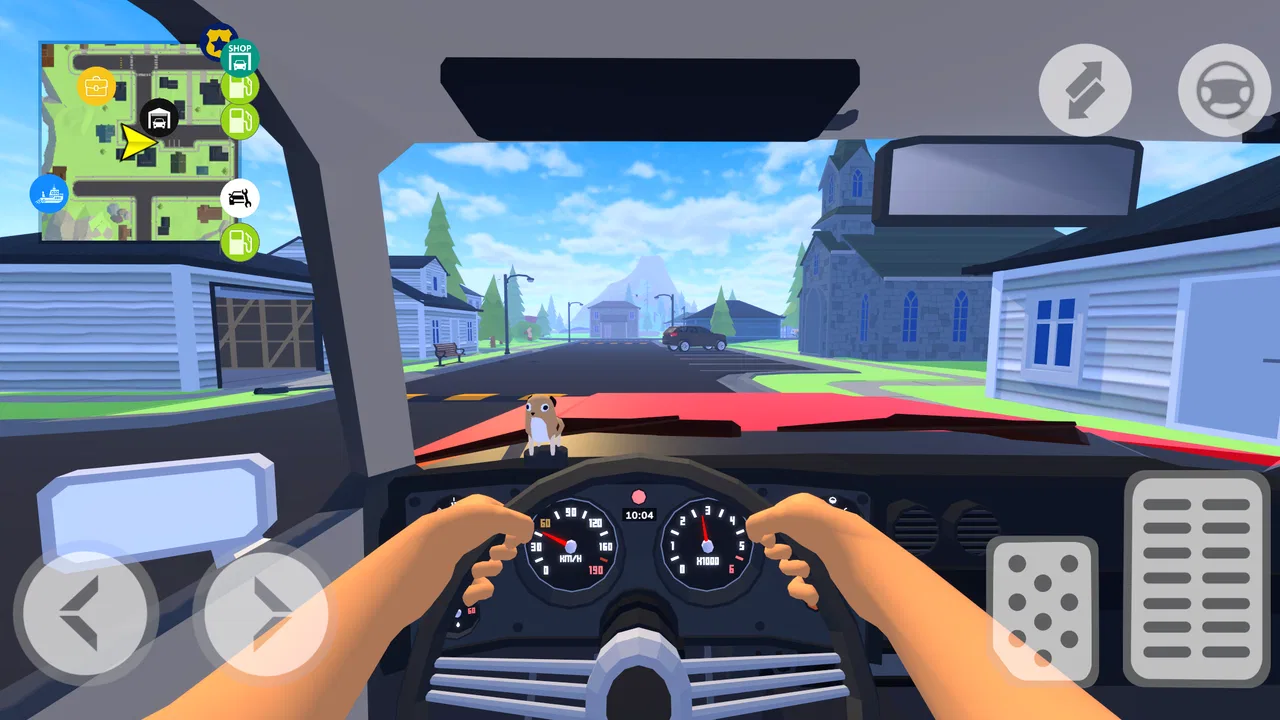
Driving Zone: Offroad Lite
- 4.2
- Rating
- 1.00M
- Installs
- Free
- Price

 Analysis by App-foxy
I spent time with Driving Zone: Offroad Lite as a mobile racing game, and its appeal became clear quite quickly: it is built around the simple pleasure of taking a car away from clean asphalt and into rougher ground. Mud, sand, and snow change the feeling of driving, so even a short session can feel different from a conventional street-racing game. I found it most enjoyable when I treated each drive as a small handling exercise rather than expecting a deep campaign with a long narrative.
That distinction matters. This is an open-world off-road simulator from AveCreation, offered as a free game for everyone. It has attracted over a million installs and holds a 4.2 average from around eight thousand ratings, which suggests that the basic driving idea has found a sizeable audience. My experience was that the game works best for players who want relaxed exploration and vehicle control, not for someone searching for a tightly structured competitive racer.
How the driving loop creates early goals
The first goals are naturally self-directed. Instead of being pushed through a dramatic story, I found myself making small plans: reach a difficult patch of terrain, test how the car behaves on a different surface, or simply complete a drive without losing control. That freedom is useful because it lets a short session begin immediately, but it also means the game does not always tell you what to care about next.
You May Also Like

 Blood Strike: 2.5 Anniversary
Blood Strike’s Loadouts Turn Every Drop Into a Tactical Gamble
A close look at Blood Strike’s custom loadouts: how fast access to signature weapons reshapes its battle royale rhythm, rewards preparation, and narrows the gap between fights.

 Pandora - Music & Podcasts
Pandora’s Music Is Easy to Start, but Harder to Recover
Pandora’s strength is its low-effort path from a seed to a station. Its weak spot is how much confidence it asks you to place in connection, setup, and quiet recovery.

 8 Ball Pool
 Is Built on Rivalries, Rematches, and Routine
A close look at the rivalries, rematches, shared routines, and unanswered safety questions that turn a quick pool match into a persistent mobile community.

 Samsung Music
’s Quiet Strength Is Playing What You Already Own
Its reach comes less from spectacle than from dependable access to a personal library. That simplicity is both the app’s strongest retention engine and its ceiling.

 AccuWeather: Weather Radar
AccuWeather Review: A Quick, Clear Forecast for Everyday Decisions
For everyday plans, the best forecast is the one you can understand quickly. AccuWeather makes rain timing, radar, and local conditions easy to act on, with a few trade-offs.

 Hill Climb Racing
Why Hill Climb Racing Still Turns Crashes Into One More Run
A tiny car, a bumpy hill and one more upgrade: Hill Climb Racing keeps resurfacing because its simple chaos makes every near-miss feel personal.
More From Our News Desk



For a new player, I recommend starting slowly rather than treating the first vehicle like a street car. Mud rewards patience, sand can make momentum feel more important, and snow encourages smoother steering. I got more from the game once I stopped trying to force every turn and began reading the surface ahead. That is one of its stronger ideas: the environment itself becomes the immediate challenge.
The open-world format also creates a practical everyday use case. If I have only a few minutes while waiting for an appointment, I can drive around and experiment without needing to remember a complicated mission chain. A longer session gives me room to explore more deliberately, but the game does not require a major time commitment before it becomes playable.
Players who need explicit objectives may find the opening less motivating. In many racing games, the next event, rival, or championship gives the session a clear purpose. Here, the pleasure comes more from choosing a route and managing the vehicle. That is a fair trade-off, but it makes the early experience dependent on whether you enjoy making your own challenges.
What makes the terrain more than decoration
The different surfaces are not just visual changes in my experience. They alter how I approach the car. On firm ground, I can be more direct with steering. In mud, I pay closer attention to speed and recovery. Snow makes abrupt corrections feel especially costly, while sand encourages me to think about maintaining enough movement to avoid turning a small mistake into a complete loss of progress.
A useful habit is to enter unfamiliar terrain with a controlled pace, then increase speed only after learning how the car responds. This is more reliable than driving at maximum speed from the start. It also gives the game a modest learning curve without needing complicated controls or a formal tutorial-heavy structure.
This is where the simulator label has some value, although I would not approach it as a fully realistic driving laboratory. The game simplifies the experience enough to remain accessible on a phone, yet the surfaces give driving a sense of consequence. I enjoyed that middle ground more than I expected, particularly when a route looked easy but required better throttle and steering discipline than the first glance suggested.
Progress signals, unlocks, and the rhythm of play
The main question for long-term players is how much progression they need before the driving remains satisfying. I noticed that the clearest progress signal is not necessarily a traditional racing result. It is the gradual improvement in how confidently I handled terrain and selected routes. A difficult section that initially felt awkward became manageable after a few attempts, and that personal improvement supplied a reason to continue.
That kind of progress is subtle. It will appeal to players who like learning a vehicle through repetition, but it may feel weak to anyone who expects a constant stream of rewards, new events, or obvious milestones. I would not recommend installing this game solely for a heavily guided unlock journey. Its motivation comes from driving and exploration first, with progression serving as support rather than dominating every session.
When considering in-game purchases, I would keep the free entry point in mind. The game costs nothing to start, while optional purchases range from $1.99 to $24.99 per item. That makes it possible to try the driving style before spending anything, which is the right approach here. I would play several sessions, decide whether the terrain and pacing genuinely hold my attention, and only then consider an optional purchase.
The trade-off is that free-to-play design can influence how strongly a player feels the need to advance. If you are sensitive to purchase prompts or dislike feeling that progress is being encouraged through spending, you should pay attention to how the game presents its optional items during your own play. I would not treat a purchase as a solution for a driving style that does not already feel enjoyable; extra content cannot fix a mismatch between the game’s relaxed structure and your preferred pace.
Why the pacing works for some players and not others
The pacing is at its best when I alternate between exploration and deliberate practice. I might spend one session simply learning a snowy route, then return later to see whether a cleaner line makes the drive easier. That loop is less dramatic than a race-by-race campaign, but it avoids making every minute feel like a test. The game gives breathing room, which suits casual play.
On the other hand, the same breathing room can become a lack of urgency. If I wanted a strong reason to replay a particular area, I had to create that reason myself. Players who enjoy time pressure, rival cars, or a clearly escalating championship may find the experience too loose. In that case, a conventional arcade racer would probably be a better fit because it turns every session into a more obvious contest.
I also think the “Lite” identity sets a useful expectation. I approached it as a focused off-road driving experience rather than a complete replacement for a large console-style racing game. That helped me appreciate the short, repeatable sessions instead of judging it by features it is not trying to foreground. The game’s strength is immediacy: choose a direction, feel the surface, correct the car, and keep moving.
Difficulty: learning control without turning every drive into a trial
The difficulty curve feels most convincing when it comes from terrain rather than arbitrary punishment. A route becomes harder because the surface demands more care, not simply because the game suddenly makes the car uncontrollable. For me, that created a fair sense of challenge. I could usually understand why a mistake happened, which made another attempt feel worthwhile.
My main advice is to avoid making speed the only measure of success. In off-road driving, a slower line can be the better line. I found that braking before a turn and entering a rough section with a little control was often more useful than trying to recover after a dramatic slide. This is a small but important shift in mindset for players arriving from fast arcade racers.
The challenge is also affected by the phone itself. Touch controls can make fine steering feel less natural than a physical controller, especially when a surface requires small corrections. I became more comfortable after using shorter inputs instead of holding a direction for too long. Anyone who expects instant precision may need a short adjustment period before deciding whether the handling suits them.
That control friction is a genuine limitation. The game’s terrain can invite careful driving, but a touchscreen is not always the ideal tool for delicate throttle and steering work. I would recommend it to mobile players who are comfortable learning touch control, while players who demand competitive precision should look toward a racing game designed more explicitly around fast, exact inputs.
Who will enjoy the challenge
This is a good match for someone who likes vehicles, open spaces, and gradual mastery. It is especially suitable for a player who wants to relax while still having something to learn. The age rating is Everyone, so the presentation is accessible for a broad audience, although younger players may still need help understanding that careful driving is more effective than constant acceleration.
I would skip it if your ideal racing session means immediate head-to-head competition, a large roster of clearly defined events, or a relentless sequence of unlocks. The game’s challenge is quieter. It asks whether you can read the ground and manage the car, not whether you can dominate a crowded starting grid every few minutes.
It is also not the right choice for someone who wants a strict simulation with extensive tuning and a detailed career structure. The off-road focus gives it personality, but the experience remains approachable. A more specialized simulator would be preferable for players who want deep mechanical adjustment, while a traditional arcade racer would be preferable for players who care more about spectacle and speed than surface management.
Retention pressure and the reason to return
The strongest reason to return is the simple desire to improve a route or spend more time with the terrain. I found myself coming back when I remembered a section that had exposed a weakness in my driving. That kind of return motivation feels healthier than playing only to clear a checklist, because it is connected directly to the central activity.
Still, retention depends heavily on personal taste. If you need a visible chain of goals to maintain interest, the open-ended structure may lose its pull after the initial curiosity fades. The game can provide a pleasant driving break, but it does not automatically create the same long-term pressure as a progression-focused racing title. I see that as a deliberate character trait rather than an outright flaw, though it limits the audience.
Optional spending can add another layer of pressure for some players. Since the game is free and includes purchasable items, I would set a personal rule before playing: enjoy the driving first and treat purchases as optional extras, not as a requirement for proving that the game is worthwhile. That approach keeps the decision grounded in actual enjoyment rather than impatience.
For a realistic routine, I could use it after work when I want something interactive but not mentally demanding. I would choose a surface, drive until I reached a difficult stretch, and stop after a few attempts rather than forcing a long session. The game fits that pattern well because it does not need a large block of uninterrupted time to make sense.
Its technical entry point is also fairly approachable for older devices, with support beginning at Android 7.1. The current version is 0.25.50, so I would check that a phone meets the requirement before installing. That is a practical consideration for anyone using an older Android handset, especially if storage, performance, or touch responsiveness is already a concern.
How it compares with familiar racing alternatives
Compared with a standard arcade racer, this game gives the road less importance and the ground more. You are not simply looking for the fastest clean line; you are responding to mud, sand, and snow. That makes it more exploratory and less immediately competitive. If you enjoy the atmosphere of driving away from city streets, it offers a distinct change of pace.
Compared with a dedicated off-road simulation, it is easier to approach but less suited to players who want every detail to be the main event. I appreciated not having to treat each drive like a technical project, yet I also understood why a serious simulation fan might want more depth. The choice depends on whether accessibility or mechanical complexity matters more to you.
Compared with endless-runner racing games, it is slower and more intentional. There is less emphasis on reflexes alone and more on choosing how to cross the landscape. That gives it a calmer identity, but it also means it may feel uneventful to players who want constant visual stimulation and rapid rewards.
My verdict on the progression and the overall experience
After playing it, I see Driving Zone: Offroad Lite as a focused free racing game whose progression is built more around growing confidence than around a heavily scripted campaign. The early goals come from exploring and testing the car, the progress signals come from handling difficult terrain more effectively, and the difficulty rises through the demands of the surfaces. That structure is coherent, even if it will not satisfy every type of racing fan.
The game is worth trying if you want an open-world off-road drive that works in short sessions, costs nothing to begin, and gives mud, sand, and snow a meaningful role in the handling. I would particularly recommend it to casual players who enjoy experimenting with routes and learning through repetition. The Everyone rating also makes it an approachable choice for a broad audience.
I would be more cautious for players who need strong objectives, competitive races, or a constant stream of unlocks. The relaxed pacing can feel refreshing, but it can also feel under-directed. Touch control requires patience, and the optional purchase range means I would avoid spending until the free experience has clearly earned your interest.
My final recommendation is simple: install it when you want an off-road driving break, not when you want a full career racer. AveCreation has centered the experience on terrain and freedom, and that focus is its biggest strength. The best way to judge it is to drive slowly at first, learn how each surface changes your approach, and decide whether that quiet improvement is enough to bring you back.
FAQs for Driving Zone: Offroad Lite
01What is Driving Zone: Offroad Lite?
Driving Zone: Offroad Lite is an off-road driving game focused on exploring rugged environments, climbing uneven terrain, and controlling vehicles on dirt roads rather than racing exclusively on smooth tracks. It offers a more relaxed driving experience, with open areas to explore, challenging surfaces, and vehicle handling that rewards careful acceleration and steering. The Lite edition is designed as a more accessible version for mobile players.
02Can I play Driving Zone: Offroad Lite without an internet connection?
The game may allow you to drive and explore some of its core content offline, which is useful when traveling or playing without mobile data. However, certain features can depend on an internet connection, including advertisements, updates, online services, or possible additional content. Before downloading, it is worth checking the current store description and testing the game in airplane mode, since offline availability can change between versions.
03Is Driving Zone: Offroad Lite free to download?
Driving Zone: Offroad Lite is generally available as a free download, allowing players to install the game and try its main driving features without paying upfront. As with many free mobile games, it may include advertising or optional purchases connected with progression, vehicles, customization, or convenience. Review the payment information on the Google Play Store or App Store before installing, especially if children will use the device.
04What devices are compatible with Driving Zone: Offroad Lite?
Compatibility depends on the operating system, device model, available storage, and the minimum requirements specified by the developer. The game should run best on relatively modern Android or iOS phones and tablets with enough memory for smooth 3D performance. Older or entry-level devices may experience longer loading times, reduced graphics quality, frame-rate drops, or occasional instability, so check the official store listing before downloading.
05Does Driving Zone: Offroad Lite offer realistic off-road driving?
The game aims to create an entertaining off-road experience through uneven landscapes, dirt surfaces, slopes, and vehicle control that feels different from ordinary road driving. It should not be treated as a full professional simulator, because handling, physics, and terrain behavior are simplified for mobile gameplay. Expect accessible controls and arcade-style enjoyment, while players seeking highly technical vehicle simulation may find the realism more limited.
Pros
- Large off-road map with varied terrain to explore freely.
- Responsive driving controls make vehicles easy to handle.
- Vehicle customization adds variety to the driving experience.
- Works well for short
- casual play sessions.
- Off-road challenges provide a relaxing alternative to racing games.
Cons
- Limited vehicle selection compared with the full version.
- Some areas and features may be locked behind progression or purchases.
- Physics can feel inconsistent on steep slopes and rough terrain.
- Repetitive objectives may reduce long-term interest.
- Graphics quality varies noticeably across different environments.

Driving Zone: Offroad Lite
Gallery